If you operate a commercial trucking business in Texas, you’ve likely heard about apportioned plates or IRP plates. These special license plates allow commercial motor vehicles to travel across multiple jurisdictions while complying with state and federal regulations. For trucking companies looking to expand operations beyond Texas, obtaining IRP plates is essential to remain legally compliant and avoid unnecessary fines. At Texas Truck Permits, we specialize in helping trucking businesses navigate the complexities of apportioned plates and the International Registration Plan (IRP). In this blog, we’ll explain what IRP plates are, how they work, and why they’re crucial for commercial truck operators in Texas.
What Is the International Registration Plan (IRP)?
The International Registration Plan (IRP) is an agreement among U.S. states, the District of Columbia, and Canadian provinces that enables commercial vehicles to operate in multiple jurisdictions with a single registration. Instead of obtaining individual permits for each state, IRP simplifies the process by distributing registration fees based on the miles traveled in each participating jurisdiction.
What Are Apportioned Plates and How Do They Work?
Apportioned plates, commonly referred to as IRP plates, are license plates issued to commercial motor vehicles that qualify under the International Registration Plan. These plates signify that the vehicle is registered under IRP and has the legal authority to operate in multiple states or provinces. Unlike standard commercial plates, which restrict trucks to intrastate travel (within Texas only), apportioned plates allow carriers to transport goods across state lines while complying with IRP regulations.
Who Needs Apportioned / IRP Plates in Texas?
Not all commercial trucks require IRP registration. Your vehicle must meet specific criteria to qualify for apportioned plates. You need IRP plates if your commercial vehicle:
- Has a gross vehicle weight rating (GVWR) of 26,000 lbs. or more
- Has three or more axles, regardless of weight
- Operates in two or more jurisdictions (crosses state or international borders for business purposes)
To know which type of plates you need you can visit the DPS website to get information. If your trucking company operates solely within Texas, you may not need IRP plates and can use a Texas-only registration instead.
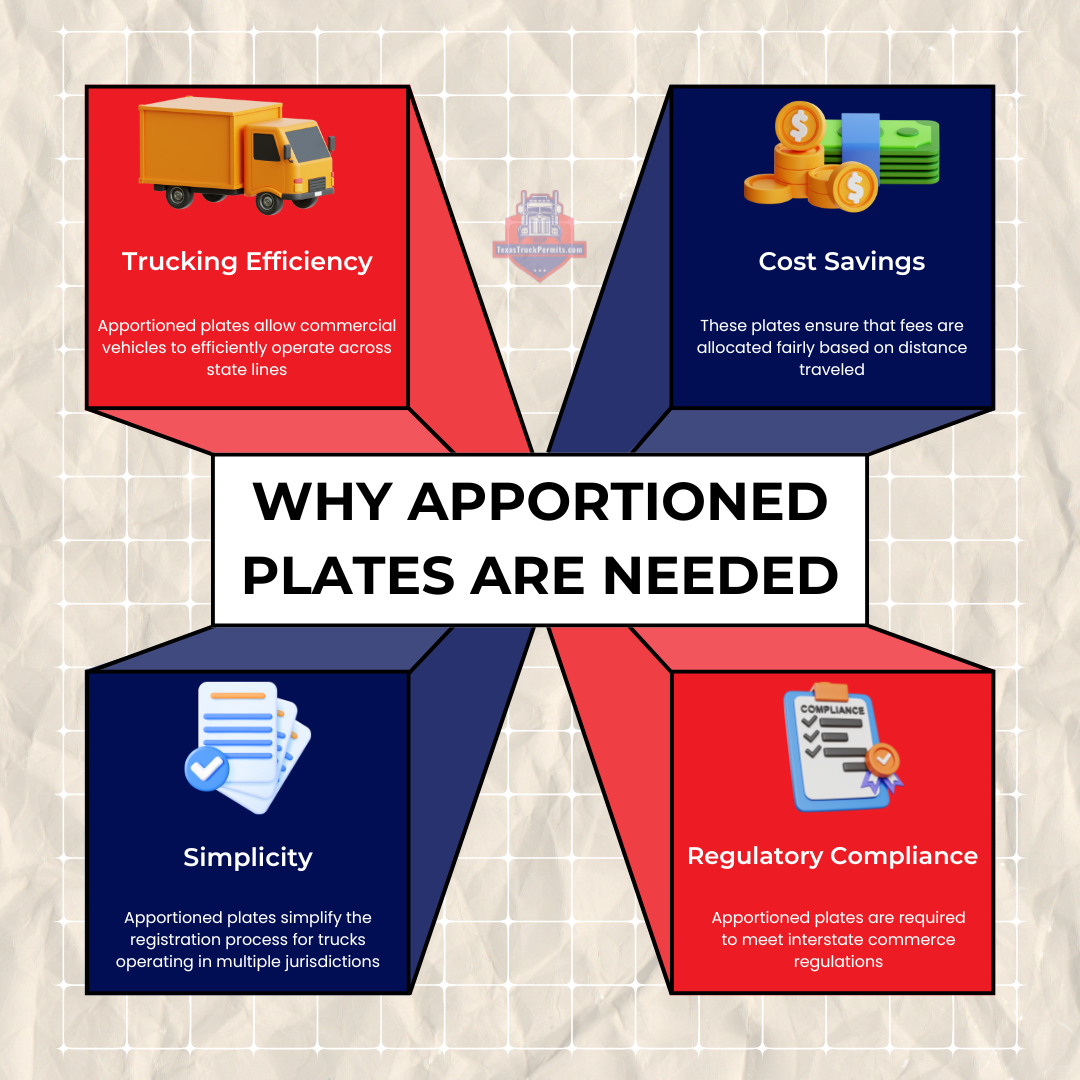
Top Benefits of IRP Plates for Texas Trucking Companies
For Texas-based trucking companies looking to expand, IRP registration offers multiple benefits:
- Simplified Registration Process: Instead of applying for separate registrations in each state, IRP allows you to operate in multiple jurisdictions under a single plate and cab card.
- Legal Compliance Across State Lines: Operating without IRP plates in states requiring apportioned registration can result in fines and vehicle impoundment. With IRP plates, you stay compliant wherever you travel.
- Cost Efficiency: Registration fees are distributed based on the percentage of miles traveled in each state, ensuring fair and proportionate tax distribution.
- Greater Business Flexibility: IRP plates enable trucking businesses to expand their routes and take on interstate contracts without administrative hurdles.
How to Apply for Apportioned Plates in Texas – Step-by-Step
Applying for IRP plates in Texas involves several steps. At Texas Truck Permits, we guide trucking businesses through the entire process to ensure a smooth and hassle-free application. Here’s what you need to do:
- Establish a Business Location in Texas – You must have a physical business address in Texas to register for IRP plates.
- Obtain a USDOT Number – If you operate a commercial vehicle, a USDOT number with the FMCSA is required for tracking safety records and regulatory compliance.
- Secure a Texas Motor Carrier (TxDMV) Number – This is required for trucks operating in Texas and crossing state lines.
- Gather Required Documents – You’ll need proof of ownership, vehicle title, lease agreements (if applicable), proof of insurance, and mileage records.
- Complete the IRP Application – Submit an IRP Schedule A & B form to the Texas Department of Motor Vehicles (TxDMV).
- Pay the Apportioned Registration Fees – Fees are calculated based on mileage percentages traveled in each jurisdiction.
- Receive Your IRP Cab Card & Apportioned Plates – Once your application is approved, you will receive a cab card listing the states your truck is registered to operate in, along with your apportioned plates.
How to Keep Your IRP Registration Up to Date
Once you have obtained IRP plates, it’s crucial to maintain compliance by:
- Renewing your IRP registration annually
- Filing accurate mileage reports for each jurisdiction
- Updating vehicle details if you add, remove, or transfer trucks
- Maintaining proper insurance coverage to meet regulatory requirements
Avoid These Common IRP Plate Application Mistakes
Applying for IRP plates can be complex, and mistakes can lead to delays or compliance issues. Some common pitfalls include:
- Incorrect mileage reporting – Inaccurate records can lead to fines or registration issues.
- Missing paperwork – Failing to submit required documents can delay your registration.
- Late renewals – Missing IRP renewal deadlines can result in penalties and suspension of your registration.
At Texas Truck Permits, we help trucking businesses navigate the IRP process with ease, ensuring all paperwork is completed correctly and submitted on time.
Get Expert Help With Your IRP Plate Registration Today
Navigating the complexities of apportioned plates and IRP registration can be challenging, but Texas Truck Permits is here to help. Our team of experts ensures your trucking company stays compliant with state and federal regulations while simplifying the registration process. If you need assistance with obtaining or renewing your IRP plates, contact Texas Truck Permits today. We’re dedicated to helping Texas truckers stay on the road legally and efficiently.
Contact Us
Call us: 832-787-2111 Email us: info@texastruckpermits.com With the right trucking permits and compliance expert support in Texas, your trucking business can expand across state lines and operate with confidence. Let Texas Truck Permits handle the paperwork so you can focus on the road ahead!